WebHarbor: Docking Real Websites for Evolving GUI Agent Environments
Executable, Dockerized reconstructions of real web services with their images, logins, carts and bookings, plus 3,518 tasks for reproducible evaluation and reinforcement learning of GUI web agents. Training exclusively on these synthetic environments, we obtain WebHarbor-4B, a state-of-the-art web agent at the 4B scale.
Hover a website to hold it·Click to explore a website
01 · 153 live websites
153 websites, each served locally and driven by an agent.
Each environment is a self-contained, locally served copy of a real website, with its own seeded database, task set and deterministic verifiers. It resets to the same state at the start of every episode. Pick a website to step through one of its tasks.
Showing 12 of 153 websites · port = 40000 + registration index
No website matches that search.
02 · Motivation
Live sites keep changing. Generated ones lack depth and fidelity.
GUI web agents need environments that look and behave like real websites, yet stay stable enough to evaluate and train on. Live websites change their content, block automation, and hide their most important workflows behind sign-in. Generated environments are controllable, but often lack functional depth, image-rich content, or login-based workflows.
38%
of Online-Mind2Web tasks were blocked by bot detection in our experiments.
22%
of WebVoyager tasks were outdated because the websites had changed.
31.8%
of WebHarbor tasks require signing in through the interface, a class of everyday workflows that live-web benchmarks rarely cover.
Environment
Curation
# Envs.
Offline
Images
Login
Evaluation
WebVoyager
Human + LLM
15
✕
✓
✕
WebArena
Human
6
✓
✓
✓
Online-Mind2Web
Human
136
✕
✓
✕
DeepShop
Agent
1
✕
✓
✕
Training
WebArena-Infinity
Agent
13
✓
✕
✕
AutoWebWorld
Agent
29
✓
△
△
CUA-Gym
Agent
98
✓
△
✕
⚓ WebHarbor
Human + Agent
153
✓
✓
✓
Released web-agent environments. Images = image-rich website content; △ = generated images or partial coverage; Login = the agent must authenticate through the interface. # Envs. follows the actual releases.
03 · Our approach
Tasks set the scope. Coding agents build. People audit.
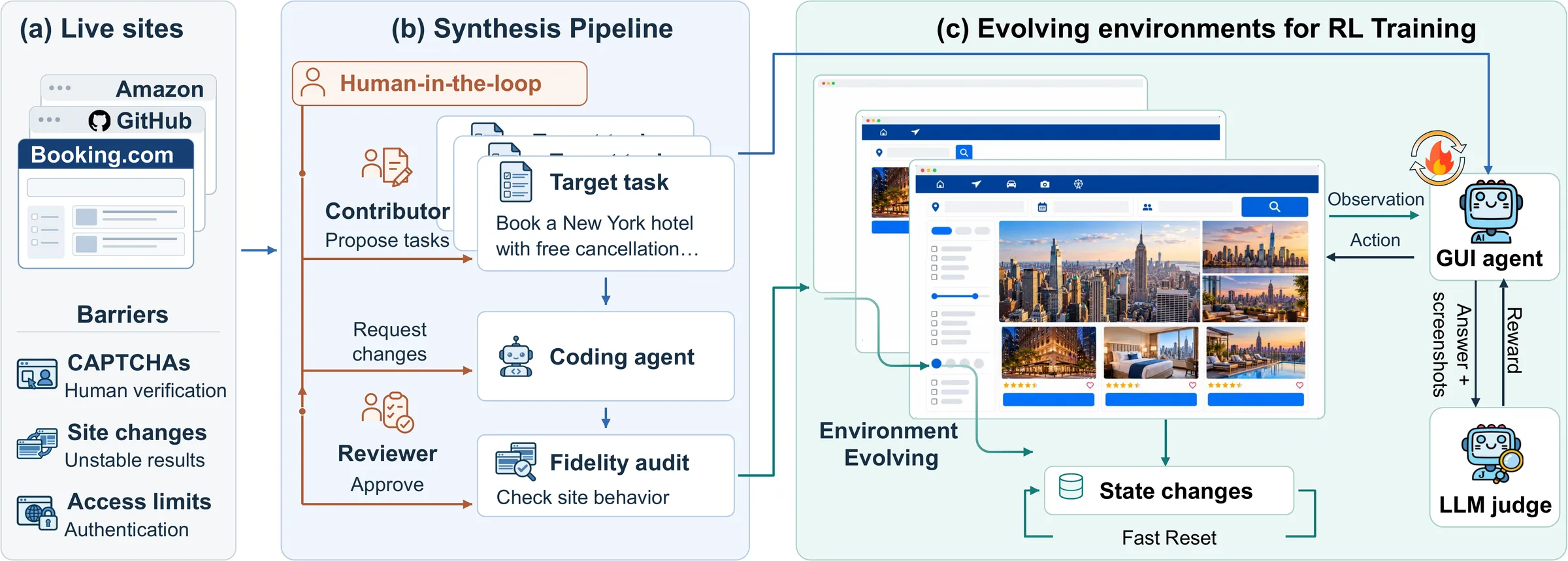
We call it docking: replacing a website's live dependencies with local assets, seeded state, and controlled resets, while keeping its recognizable look and behavior. Environments keep evolving: new tasks expose missing functionality, and the same loop extends the site.
(a) Live sites are blocked by CAPTCHAs, drift, and login walls. (b) Contributors propose tasks, coding agents build, reviewers audit. (c) The docked environments evolve and serve RL training with fast resets.
01
Task-driven docking
Cloning Amazon's catalog or YouTube's library is impractical, so each environment is scoped to its target tasks: their entry and terminal pages, the entities they inspect, the browser actions they need, and the state they change. We start from WebVoyager's 15 websites and 643 tasks, then cover every website in Online-Mind2Web with new authenticated, state-changing workflows.
Environments keep near-miss alternatives and natural navigation paths, so there are no trivial shortcuts to the answer.
02
Skill-driven synthesis & evolution
A coding agent explores the real site in a browser and records its page hierarchy, URL patterns, controls and appearance. Guided by reusable construction skills, it builds a self-contained web app backed by SQLite with bundled images. It then runs every target task, fixes the first unsupported page or state transition, resets, and runs the task again.
Missing pages become new routes; incomplete workflows get form handlers and persistent state; thin content gets new records.
03
Human-in-the-loop refinement
Contributors propose websites and functional requirements and steer the coding agent. Reviewers compare each environment with the real site, execute every task end to end, turn defects into concrete requests for the coding agent, and write task-specific verifiers and judge rubrics.
In a pilot of 26 websites, coding agents left 13 with visual or asset defects and 14 with broken or shallow interactions. Each environment gets 2–3 review rounds of 1–2 hours.
04 · The suite
Image-rich, deep, and stateful.
Five months of community collaboration produced 153 executable website environments with 3,518 tasks. More than half of the tasks need reasoning across pages, and over a third change persistent state.
Task coverage 3,518 tasks
Task category mutually exclusive
Task property can overlap
LLM-based classification of all tasks. Hover a bar for counts, shares and website coverage.
Environment complexity vs. synthetic suites
37.3pages per environment
1,320bundled images per environment
104.8MiB of images per environment
6,611lines of code per environment
Train / test split hover a segment
3,518taskson 153 websites
Train tasks2,288
Test tasks (verified)306
Unallocated tasks924
Train-covered websites123
WebVoyager sites, held out15
Random sites, held out15
Outer ring: tasks. Inner ring: websites. Test candidates were run with five models; only tasks where scripted verifiers and an OpenCode agent judge agree on most runs are kept, at most two per website.
Built for RL seconds per operation
End-to-end latency in isolated, deterministically seeded sandboxes (Orchard), including data transfer and sandbox management.
SQLitestate per site, restored from a seed snapshot on reset
Offlineno live-web traffic; every asset ships with the environment
05 · Results
A 4B agent trained in WebHarbor transfers to the live web.
WebHarbor-4B starts from the same OpenWebRL-4B-SFT checkpoint and uses the same multimodal GRPO objective and GUI harness as OpenWebRL-4B, which was trained on 2,102 tasks across 704 live websites. Only the environments and tasks differ. All 15 WebVoyager websites are held out of training, and Online-Mind2Web's own tasks are not in the suite.
75.8live-web average: +5.2 over OpenWebRL-4B and +22.2 over the shared SFT checkpoint
28.8on WebArena, the best 4B model, in environments never seen in training
−2.7drop when WebArena auto-login is disabled, vs −3.6 and −4.9 for the OpenWebRL models
Live web
Invalid trials (e.g. reCAPTCHA) excluded. Numbers other than WebHarbor-4B as reported by OpenWebRL.
Benchmark fidelity hover a model
6 / 6pairwise rankings preserved
1.00Spearman rank correlation
0.80Pearson score correlation
Agents score 4.4–18.8 points higher on WebHarbor than on the live sites, because content drift and access restrictions no longer interfere, while their relative order is unchanged.
WebHarbor test set 306 verified tasks
Frontier models approach saturation, while 4B agents leave plenty of headroom.
WebArena 4B models, 226 tasks
"No auto-login" gives the credentials in the task instead of signing the agent in; the change from the auto-login score is shown in brackets.
Where RL helps success rate by task capability
OpenWebRL-4B-SFTOpenWebRL-4BWebHarbor-4Bgain over OpenWebRL-4B
WebHarbor-4B improves over OpenWebRL-4B on every capability group on both benchmarks (paired tests, p < 0.01), most on authenticated, multi-page and stateful workflows.
06 · Quickstart
One image. 153 websites. One port each.
All 153 environments ship in one image on Docker Hub, wildawm/webharbor. Site i listens on port 40000 + i, and a token-protected control plane on :8101 resets any site to its seeded state.
pull & run
# the control plane requires a token of at least 32 charactersexport WEBSYN_CONTROL_TOKEN="$(python3 -c 'import secrets; print(secrets.token_urlsafe(48))')"# all 153 sites in one image (about 20 GB)docker run -e WEBSYN_CONTROL_TOKEN -p 8101:8101 \
-p 40000-40152:40000-40152 wildawm/webharbor:latest
Open http://localhost:40001 for Amazon, :40060 for YouTube, … through :40152 for SEC.gov. The control plane starts once every site is ready, about 2–3 minutes in.
One site per image for Harbor evaluation and RL: wildawm/webharbor:<site>-v1, e.g. wildawm/webharbor:amazon-v1. To build from source instead, run ./scripts/build.sh in the repository.
Each site has sites/<site>/tasks.jsonl; every task carries a judge rubric and a deterministic verifier at sites/<site>/verify/.
reset & run an agent
# restore one site, or all of them in parallelcurl -H "Authorization: Bearer $WEBSYN_CONTROL_TOKEN" \
-X POST http://localhost:8101/reset/amazon
curl -H "Authorization: Bearer $WEBSYN_CONTROL_TOKEN" \
-X POST http://localhost:8101/reset-all
# minimal ReAct agent + LLM-as-judge gradercd agent_demo && uv sync && uv run playwright install chromium
uv run python agent.py --tasks_file ../sites/amazon/tasks.jsonl \
--task_id "Amazon--0" --out_dir runs/amazon0
uv run python eval_judge.py --run_dir runs/amazon0
07 · Community
Built in the open by 57 contributors.
WebHarbor was initiated by UNC-Chapel Hill and Microsoft and built together with volunteers from the research community, who proposed websites, steered coding agents, and reviewed each other's environments.
348GitHub pull requests, 89.9% merged
192asset pull requests on Hugging Face
33 / 29contributors / reviewers (22 in both roles)
3.3people involved per website, on average
Contributions
Contributions to the current release are closed. Thank you to everyone who built and reviewed a website. The contribution guide and review guide stay online for reference.
Project leads
Zhaoyang Wang1, Qianhui Wu2
Core contributors
Boyu Gou3, Demi Wang4, Jiacheng Zhang5, Peichun Hua6, Qize Li7, Shi Qiu1, Yifan Jiang8, Yifan Zhang9, Zexu Jin7
@misc{webharbor2026,
  title        = {WebHarbor: Docking Real Websites for Evolving GUI Agent Environments},
  author       = {{WebHarbor Team and Contributors}},
  year         = {2026},
  url          = {https://aiming-lab.github.io/webharbor.github.io},
  note         = {Project website.}
}